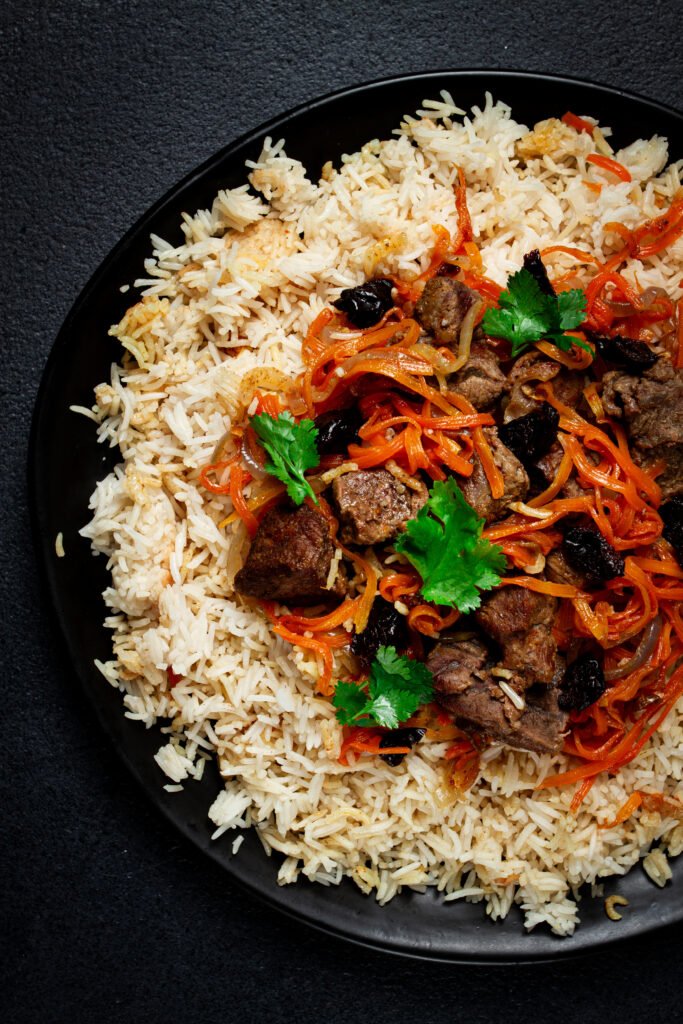
This is lamb pilau the way it should be, rice that carries every layer of the braise, lamb so tender it yields to a spoon, and a golden crust at the bottom of the pot worth fighting over. Roosma Garam Masala does the heavy lifting here: its black cardamom and star anise give the stock that deep, resinous warmth, while the coriander and cumin hold everything together. Add it at two stages, into the braise and again off the heat, and the result is complex in a way that takes years to achieve any other way.
Ingredients
For the lamb
- 800g bone-in lamb shoulder, cut into large pieces (bone-in is non-negotiable, it makes the stock)
- 2 tbsp ghee or neutral oil
- 2 medium onions, finely sliced
- 6 garlic cloves, crushed
- 1 tbsp fresh ginger, grated
- 2 tsp Roosma Garam Masala (first addition, into the braise)
- 1 tsp fine sea salt
- 1.2 litres cold water
For the rice
- 400g basmati rice, washed and soaked 30 minutes, then drained
- 2 tbsp ghee
- 1 large onion, finely sliced
- 4 green cardamom pods, lightly crushed
- 1 cinnamon stick
- 2 bay leaves
- 1 tsp Roosma Garam Masala (second addition, off the heat)
- Salt to taste
To finish
- Large pinch of saffron steeped in 3 tbsp warm milk (optional, see the biryani note below)
- Handful of fried onions (crisp, deep golden, not burnt)
- Fresh coriander, roughly chopped
- Toasted flaked almonds (optional, but worth it)
Method
Step 1: Sear the lamb
Pat the lamb dry. Heat the ghee in a wide, heavy pot over high heat until shimmering. Sear the lamb pieces in batches, no crowding, until deeply browned on all sides, 3-4 minutes per side. This colour is the flavour. Set aside.
Step 2: Build the base
In the same pot, fry the sliced onions over medium heat until soft and beginning to turn golden, about 12 minutes. Add the garlic and ginger, cook for 2 minutes until the raw smell disappears. Return the lamb to the pot.
Step 3: Season and braise
Add 2 tsp Roosma Garam Masala and 1 tsp salt, stir to coat the meat. Pour in the cold water, it should just cover the lamb. Bring to a boil, skim any foam, then reduce to a low simmer. Cover and cook for 1 hour until the lamb is tender and the stock is deeply flavoured. Remove the lamb and set aside. Reserve the stock, you need 700ml for the rice. Top up with water if short, reduce if over.
Step 4: Fry the rice base
In a separate wide, heavy pot, heat the ghee over medium heat. Fry the sliced onion until deep golden and beginning to crisp, about 15 minutes. Add the cardamom pods, cinnamon stick and bay leaves and fry for 1 minute. Add the drained rice and toast gently, stirring, for 2 minutes, the grains should feel slightly dry and turn opaque at the edges.
Step 5: Cook the rice
Pour the reserved lamb stock (700ml, hot) over the rice. Taste for salt and adjust, the water should taste noticeably seasoned. Lay the braised lamb pieces on top of the rice. Bring to a boil, then immediately reduce to the lowest heat, cover tightly and cook for 18 minutes undisturbed. Do not lift the lid.
Step 6: Rest and finish
Turn off the heat. Drizzle the saffron milk over the surface, if using. Place a clean tea towel under the lid to absorb steam, then rest for 10 minutes. This is what gives pilau its distinctly separate, fluffy grains rather than a clump. Remove the lid, fluff gently from the edges with a wide spoon, then sprinkle over the second teaspoon of Roosma Garam Masala directly onto the hot rice. The heat will bloom the spices and release the oils, the cardamom, star anise and cinnamon in the blend are especially fragrant at this stage. Top with fried onions, fresh coriander and almonds. Serve from the pot.
The spice sachet, already in the packet
Traditional yakhni pulao starts with a potli, a little muslin bag of whole spices tied up and dropped into the stock: cinnamon, coriander seeds, black peppercorns, bay leaves, green and black cardamom, cloves, star anise. It flavours the yakhni, then gets fished out so nobody bites down on a clove. Now read the back of the Roosma Garam Masala packet: black pepper, cinnamon, cloves, black cardamom, star anise, coriander, bay. The same list, ground and balanced. That’s not a coincidence, it’s the same job done without the muslin. It’s why this recipe gets away with so few whole spices, and why the blend goes in twice, once to build the stock and once at the end when the heat blooms it open.
Pilau or biryani, and where the saffron fits
People fall out over this at weddings, so here’s the short version. Pilau cooks raw rice in the seasoned stock, so every grain drinks the flavour as it swells. Biryani part-cooks the rice separately, then layers it with the meat and finishes on steam. Pilau is subtle and savoury. Biryani is loud and layered. The saffron milk in this recipe is, strictly speaking, a biryani habit that wandered over, a proper Pakistani pulao doesn’t use it. We’ve kept it because the colour and perfume are lovely, but it’s marked optional for a reason. Skip it and you’re cooking the honest, traditional thing. Use it and you’ve dressed it up for company. Both bowls come back empty.
Slow cooker lamb pilau
The braise is where a slow cooker earns its keep. Do steps 1 and 2 in a pan as written, then move everything into the slow cooker with 900ml of water instead of 1.2 litres, nothing evaporates under that lid. Low for 5-6 hours and the stock comes out even deeper than the stovetop version. Then back to the hob: strain off your 700ml of yakhni and carry on from step 4 exactly as written. Don’t be tempted to cook the rice in the slow cooker itself. It can’t do the dum, and the dum is where the fluffy, separate grains come from.
Which pilau is this?
Search for lamb pilau and you’ll meet at least three dishes wearing the same name. This one is the Pakistani yakhni pulao, defined by the bone stock and warm rather than hot spicing. The Turkish version is a different animal, buttery, often with nuts and sometimes dried fruit through it. East African pilau, the Kenyan and coastal kind, runs darker and hotter with its own masala. All of them are proper pilaus and none of them are wrong. But if what you’re after is the one from the wedding, the one where the rice tastes like the lamb, this is that one.
Notes
- The stock is everything. Don’t rush the braise, a short braise gives thin, flat-tasting stock and tough meat. Pilau is a dish that rewards patience at step 3.
- Why two additions of Garam Masala? The first addition into the braise gives the stock depth and warmth. The second, added off the heat, preserves the volatile top notes, the star anise brightness and the black cardamom smokiness, that would be cooked out otherwise.
- The sokhta (bottom crust). If you want a crisp rice crust, after adding the rice water in step 5, allow it to come to a boil, then cover with foil before the lid, and cook on very low heat for 25 minutes. The foil traps moisture above while the base crisps below.
- Bone-in vs boneless. Bone-in shoulder gives a richer, more gelatinous stock. Boneless works but reduce your braise time to 45 minutes and expect a thinner flavour, compensate with an extra ½ tsp Garam Masala in the stock.
← Back to all recipes
All Roosma recipes →